A small test in your own room
1 of 4
A small test, not a project
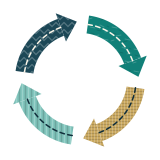
Plan a change. Act on it. Observe what happens. Reflect on what it showed. That is action research, and it does not need a university. It needs one group, two weeks and something you can count. You run it on your own. Nothing is handed in.
For examplePlan. Act. Observe. Reflect. Then round again.

Pick an activity. Each takes two or three minutes.
A fair test of one idea, in one room, in two weeks.
Why this works in your room
Change one thing, count something, and you know whether it worked.
For your learners: They get a change that has been tried and looked at, not a new idea every week.
For you: In two weeks you have evidence from your own room, which is worth more than a hunch.
Plan
What bothers me?
What one change might help?
What will I count?
Act
One group.
Every lesson.
Two weeks.
Observe
Count before.
Count during.
The same way each time.
Reflect
On the date I set.
Did the number move? Why?
Keep, change or drop.
Watch out for
Judging it on day one.
Trying something new before asking why.
Elsewhere in Bradford ThreadWorks
 Big 4A short quiz in Forms, to count the same thing before and after.Open Big 4 (opens in a new tab)
 WalkThrusEveryone thinking, everyone answering: mini whiteboards and cold calling, as the one change to test.Open WalkThrus (opens in a new tab)
 RAISEBetween visits: small things to try, tied to your own target.Open RAISE (opens in a new tab)
Prompts to paste into Copilot
Copilot can help you keep a test fair and make sense of a tally. Change what is in brackets, and leave out learners' names.
Design my test
I teach [subject] to [level] learners. The thing I want to change is [what bothers me]. Suggest three single changes I could test with one group for two weeks. For each, tell me one thing I could count in the lesson, on a sticky note, to see if it worked.
Make sense of my tally
Before I changed anything, my count was [numbers]. Over two weeks with [the change], it was [numbers]. Tell me plainly what this does and does not show, what else could explain it, and what I should test next.
Where it comes from
Kurt Lewin coined the term action research in the 1940s: research done by the people doing the work, to improve the work. Stephen Kemmis and Robin McTaggart set it out for teachers as plan, act, observe, reflect, each lap starting from what the last one showed.
Lewin, 1946; Kemmis and McTaggart, 1988 (opens in a new tab)Kolb's cycle, and a caution
David Kolb's 1984 cycle (do, look back, make sense, try differently) is why Reflect asks why. His point: experience alone teaches little. It is often sold with a learning styles quiz. A review found no good evidence for teaching to a style. Use the cycle, leave the quiz.
Kolb, 1984; Pashler, McDaniel, Rohrer and Bjork, 2008 (opens in a new tab)How sure is this?
Honest, not proven. A test with one group is evidence about your learners in your room, not proof that something works everywhere. Two weeks and a tally can show a big change and miss a small one. The cycle is well established; we found no study of tutors running it alone.
No source claimed